Pfarrkirche St. Anna
Church

Description
The church building is a simple south-facing baroque building (around 1750) with extensions. The free-standing gable façade with roof riders concealed behind it dates from the second half of the 19th century. The side facades are largely obstructed by neighboring houses. A staircase to the gallery and tower is attached on the west side. To the east is the choir of the medieval Hedwig Chapel with an adjoining corridor to the sacristy (around 1840).
The nave has two bays and is adjoined by a three-stage raised, almost square choir with a round apse niche. On the east side of the choir is a late-Baroque sacristy door. Above it is a segmental arched four-light oratory window with a fanlight and ornamental stained glass panes.
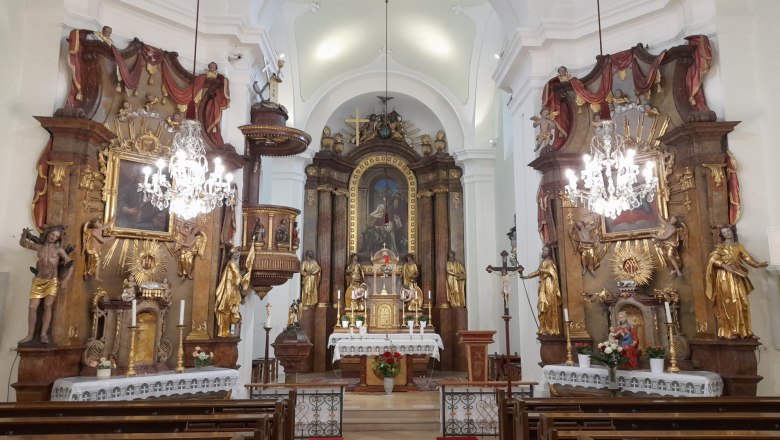
The high altar dates from 1833 and is in a classicist style. The altarpiece is a gift from the Prince of Liechtenstein. It shows St. Mary with her parents, St. Joachim and St. Anne.
The two side altars in late Baroque style date from the 18th century. The left side altar, with the statues of St. Sebastian and St. Florian, is dedicated to St. John of Nepomuk. (The right side altar is called the Marian altar. Next to the "Mariahilfbild" are the statues of St. Joseph and St. John the Evangelist.
On the east side of the church is St. Hedwig's Chapel. This chapel was built at the beginning of the 16th century as a branch church of St. Georgen/Ybbsfeld. It is therefore the oldest part of the church. The altarpiece, a depiction of St. Hedwig kneeling in front of the crucifix, was painted by the baroque painter Martin Johann Schmidt (Kremser-Schmidt). According to the chronicles, the painting is said to be a gift from a Countess of Zinzendorf. There is a Pietá on the altar table. The Holy Sepulchre is located in St. Hedwig's Chapel during Holy Week.
The pulpit is a round, classicist Biedermeier hanging pulpit with a gadrooned console and friezes made of pearl and egg bars, tongue ribs and notches; the parapet has a gilded pilaster structure with colorful seated figures of the four evangelists and Jesus Christ on wide consoles.
The original four bells fell victim to the Second World War in 1940, leaving only one little train bell. Three new bells were consecrated on August 29, 1948. The bells have the notes a, c sharp and e, the diameters 93, 71 and 61 cm and weigh 400, 195 and 120 kg. The inscriptions read: Trinity bell, St. Anne's bell and St. Joseph's bell. On all bells: "Meister Johann Dettewieder der OÖ. Glockengießerei St. Florian cast me for the parish church of Blindenmarkt". The little train bell, which survived the two world wars, weighs 50 kg and has a diameter of 42 cm. It was cast in 1876 by Staffelmaier in Steyr.
After several fires, the church had to be renovated again and again. Especially during the Second World War, when the market was bombed in May 1945, it suffered extensive damage, which was repaired by a general renovation.
Today, the church is very beautiful and appealing both inside and out thanks to its elegant simplicity.
In 1785, the princely Starhemberg estate agreed to take over the patronage and exercised this function until 1937. From 1937, Rupert Hatschek and his family took over the patronage. The Hatschek family is still a great support to us today in many church matters.