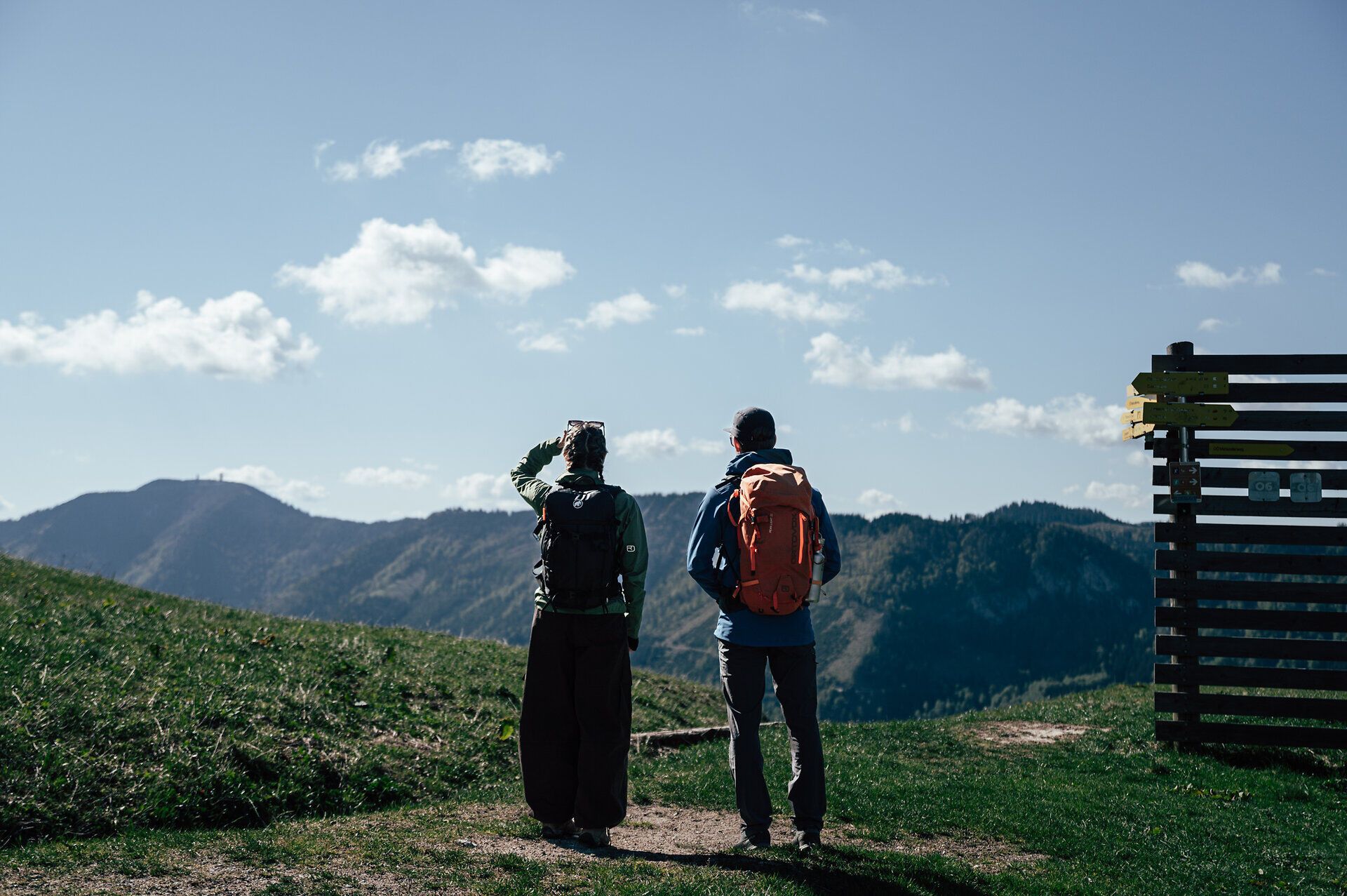
Three mountains clearly set the tone here: the Ötscher, the Dürrenstein and the Hochkar. In between lie valleys, forests, alpine pastures and water that carves its own path anyway.
The Ybbstal Alps are a region defined by its landscape. But that’s not all. For centuries, iron and wood have shaped work and everyday life here. Hammer mills and smithies still bear witness to this today. Alpine pastures, farms and small villages are just as much a part of it.
Perhaps it is precisely these contrasts that define the Ybbstal Alps. Rock and water. Forest and meadow. A long history and people who have long since moved on to writing their own chapters.
And right in the middle of it all are three mountains that serve as excellent landmarks.

Here, where you can really feel at home and being outdoors is simply part of life, it makes me proud that we don’t just put our traditions and customs in a museum, but actually live them. The natural landscape and the abundance of nature reserves offer plenty of space to recharge your batteries and get active: the variety – whether on any sort of bike, on snowboards in winter, or in trekking or mountaineering boots – allows me to discover new aspects of my home, the Ybbstal Alps, every day.
D for Dürrenstein
Woodland, mountains and plenty of open space in between. All around, the region reveals its tranquil side.
E for Iron
Has shaped the area for generations. In forges, hammer mills and along the Eisenstraße.
H for Hochkar
At 1,808 metres, one of the highest points in the region. And with views to match.
L for Lunzer See
A lake nestled amongst the mountains. That really says it all.
Ö for Ötscher
Striking, visible from afar and a landmark that makes it quite easy to find your way around.
R for Rothschild Castle
Right in the heart of Waidhofen an der Ybbs, ancient walls meet surprisingly modern architecture. A castle that shows history doesn’t have to stand still.
Y for the Ybbs
River Winding its way through the region, it ensures that water is rarely far away here.